If you just watched that breakdown on bacterial biofilms and how they relate to that persistent ammonia or pee smell, you already understand more about what is happening in your body than most women are ever told.

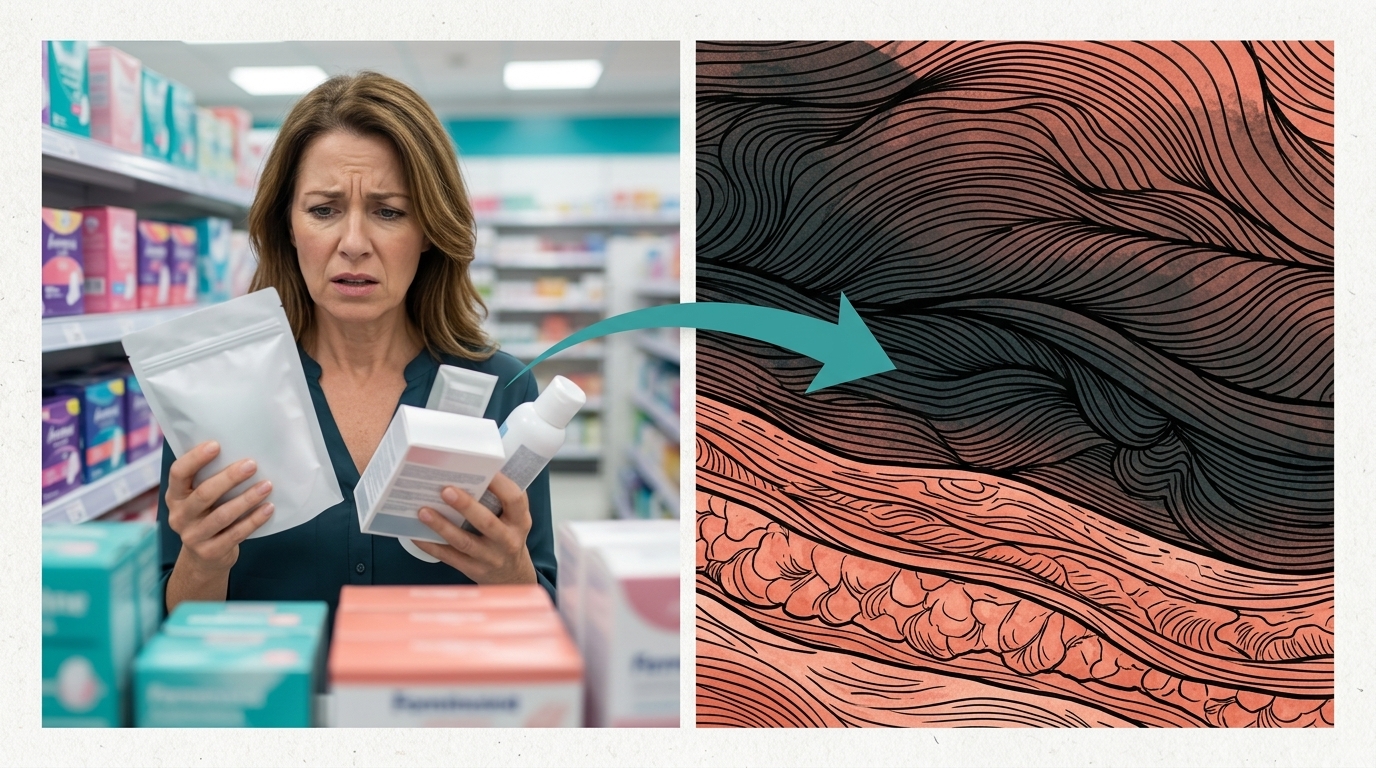
Here is the short version of what you learned: the odor, the irritation, and that general off feeling are not caused by poor hygiene.
They are caused by an overgrowth of bad vaginal bacteria that builds protective protein shields — biofilms — on the vaginal walls.
These biofilms are why boric acid, basic probiotics, and antibiotics provide temporary relief but never fix the problem long term. The bacteria underneath survives, and grows back.
But I want to go deeper. Because understanding the mechanism is one thing. Seeing the published evidence behind it is what gives you the confidence to finally change your approach.
For a long time, bacterial vaginosis and recurring vaginal odor were treated as surface-level infections. Antibiotics, suppositories, washes. Treat the symptom, hope it goes away.
But the research has shifted. A 2024 narrative review published in the Indian Journal of Dermatology, Venereology and Leprology found that bacterial vaginosis "has garnered recent research attention due to the significance of biofilms in its pathogenesis."
In plain language: researchers now recognize that biofilms are central to why BV keeps coming back.
And it goes even further than that. A separate 2024 study by Swidsinski and colleagues, published in Microbes and Infection, found that the bacterial communities forming these biofilms are not just a side effect of infection — they are the infection.
These organized bacterial consortia are "the true pathogens responsible for many infectious conditions." — Swidsinski et al., Microbes and Infection, 2024
This is an important distinction. The odor is not separate from the biofilm. The biofilm is the structure that allows the odor-causing bacteria to survive everything you throw at them.
So when someone says "odor is caused by infection, not biofilms" — they are actually describing the same problem. The biofilm is what makes the infection recur.
This is where things get frustrating for women who feel like they have tried everything.
Boric acid can temporarily shift the surface pH environment. Vaginal washes clean the external area. Oregano oil and coconut oil have mild antimicrobial properties on contact. Even drinking more water supports general health.
But none of these can penetrate a physical protein structure attached to the vaginal wall.
Think of it this way. The biofilm is not floating around waiting to be washed away. It is built into the tissue.
It has a structural matrix — proteins and polysaccharides woven together — that physically shields the bacteria inside from anything on the surface.
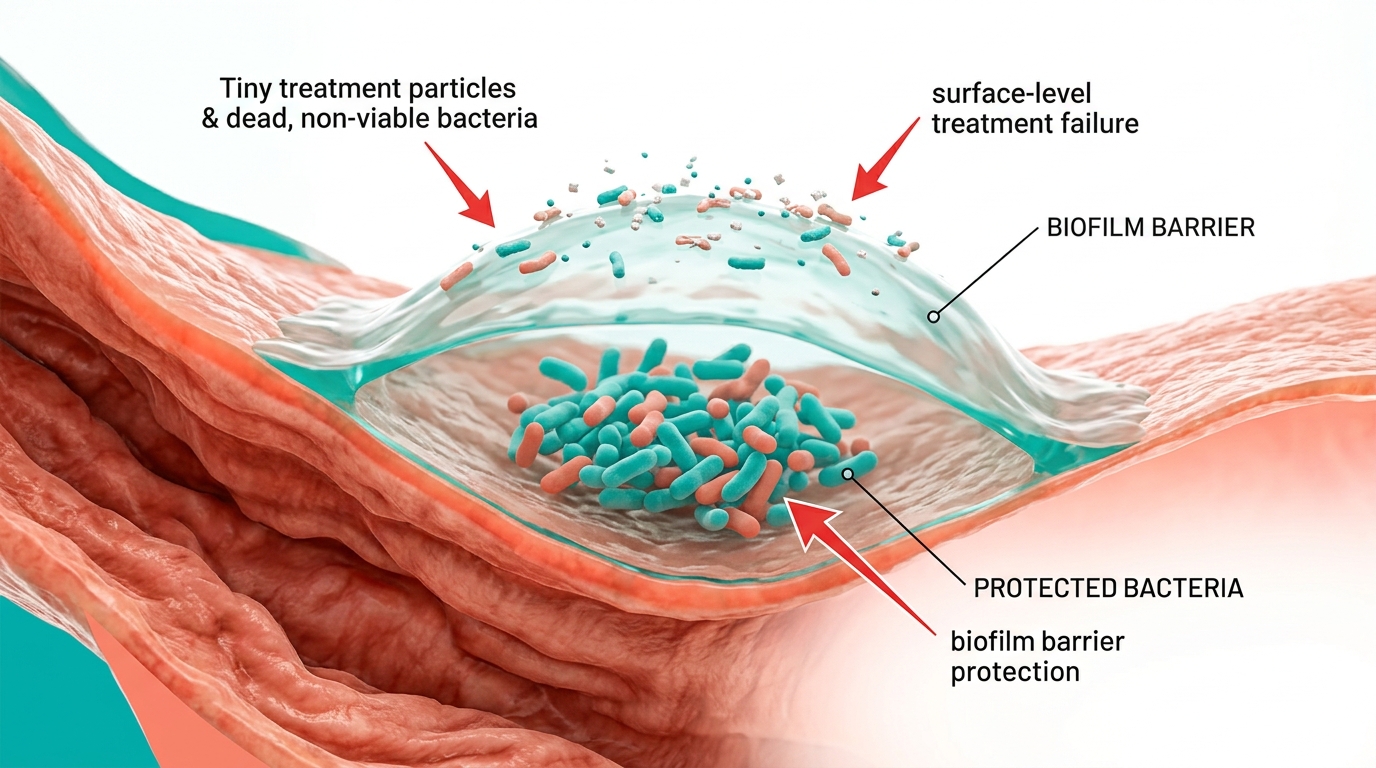
And this is where it gets worse. As I explained in the video, when you take probiotics without addressing the biofilm first, the bad bacteria can sense the competitive pressure.
Research has documented a process called dispersal — where the threatened bacteria respond by spreading, creating new mini biofilm colonies across the vaginal microbiome.
These secondary biofilms are often thicker and harder to break than the original.
This is why so many women who have taken probiotics for months feel like the smell never goes away, or even gets worse over time.
It is not that probiotics are bad. It is that probiotics alone, without breaking the biofilm first, can trigger the exact response you are trying to prevent.
Disruption of vaginal microbiota equilibrium promotes infectious clinical syndromes with annoying symptoms, such as vaginal discharge, odour, irritation, pruritus, and vulvar burning. — Tsimaris et al., Beneficial Microbes, 2019
The symptoms are real. The mechanism behind them is structural. And the solution has to match.
After watching the video, some of you may be thinking: great, I just need bromelain. I will go buy a bromelain supplement.
I understand that instinct. But there are three things to know before you do.
First, source matters.
Bromelain is an enzyme found in pineapple stems — not in the fruit flesh, not in pineapple juice, not in pineapple flavoring.
Most pineapple-marketed gummies and supplements on the market use pineapple fruit extract or pineapple flavoring, which contains negligible bromelain enzyme activity.
The label may say pineapple. It may even say bromelain. But unless the bromelain is stem-derived and dosed at a clinically meaningful level, it is not doing what you need it to do.
Second, dose matters.
A sprinkle of bromelain in a multivitamin gummy is not the same as a clinical dose. The biofilm is a physical protein structure.
Dissolving it requires enough enzymatic activity to actually degrade the matrix. Underdosed bromelain is like using a squirt gun on a brick wall.
Third — and this is the one most people miss — bromelain alone is only half the protocol.
Dissolving the biofilm creates a window. For a brief period, the vaginal wall is exposed and the bacterial environment is disrupted.
If you do nothing during that window, the fastest-growing bacteria recolonize first. And in a disrupted vaginal microbiome, the fastest growers are usually the bad bacteria.
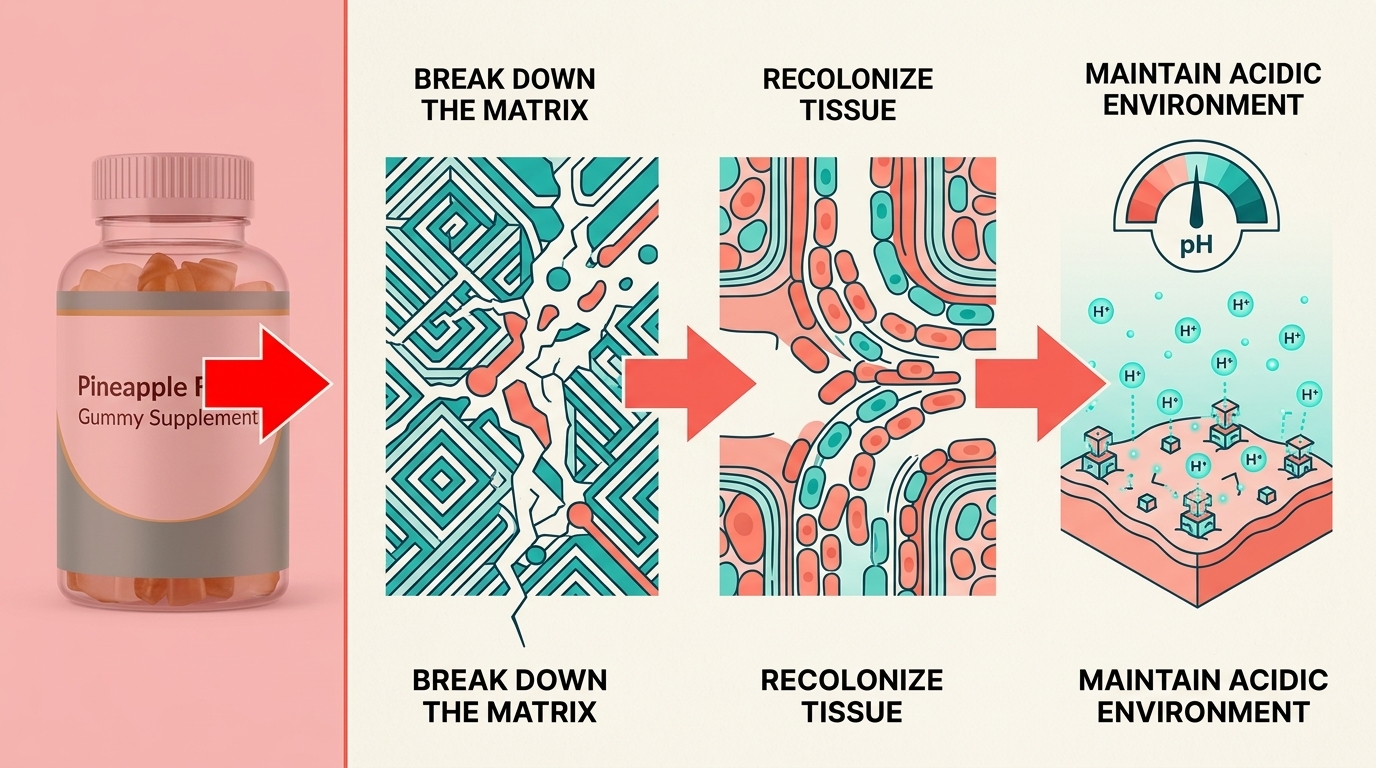
Here is the logic in sequence:
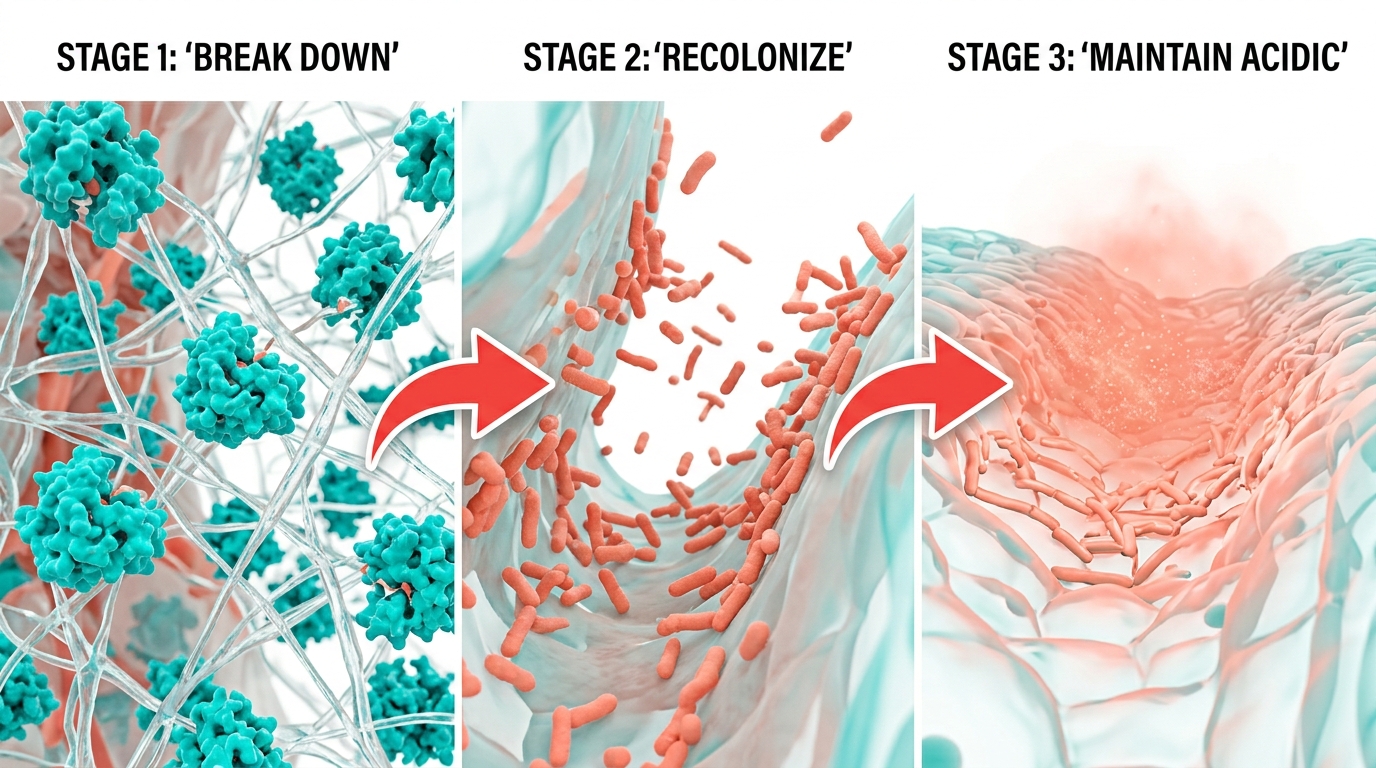
Step one: stem-derived bromelain at clinical dose breaks down the protein structure of the biofilm matrix.
This strips away the protective shield that has been keeping the odor-causing bacteria safe from your immune system and from every other treatment you have tried.
Step two: a spore-forming probiotic immediately begins recolonizing the disrupted environment with beneficial bacteria.
Spore-forming is the key word here. Most probiotic strains are fragile — they die in stomach acid before they ever reach the vaginal microbiome.
Spore-forming strains like bacillus coagulans are encased in a natural protective shell that allows them to survive digestion, arrive intact, and begin rebuilding a healthy bacterial balance.
The specific strain that the research supports is bacillus coagulans SNZ1969. Not a generic probiotic blend. Not a random Lactobacillus. A specific, named, traceable spore-forming strain.
A 2025 randomized, double-blind, controlled study published in Communications Medicine confirmed that oral probiotic intake significantly reduced BV severity scores compared to placebo.
But only when the biofilm is not in the way.
Vitamin C rounds out the formula by supporting an acidic vaginal pH during recolonization — the environment where good bacteria thrive and bad bacteria struggle.
If you have been dealing with this for years — if your doctor has told you to take antibiotics again, or worse, that it is in your head — you are not alone and you are not crazy.
Biofilm research in vaginal health is still catching up. The 2024 Lachyan review specifically describes it as a recent area of research attention.
Many clinicians are still trained on the antibiotic model: identify the bacteria, kill the bacteria, problem solved. But when the bacteria are protected by a biofilm structure, killing them becomes almost impossible without addressing the structure first.
The studies cited on this page come from research institutions across four countries. They are published in peer-reviewed journals. They have nothing to do with any supplement brand. The mechanism is the mechanism, regardless of who is explaining it.
What has changed in the last few years is that the research has reached a critical mass.
The role of biofilms in BV pathogenesis is no longer speculative. The enzymatic disruption approach is no longer theoretical.
And the ability to combine biofilm disruption with spore-forming probiotic recolonization in a single daily formula is no longer impossible.
Think about what you have already spent.
A round of boric acid suppositories: $15 to $30, and you may have bought several rounds.
A monthly probiotic subscription: $25 to $45 per month, sometimes for years.
Feminine hygiene products — sprays, wipes, washes, deodorants: $10 to $20 each, bought regularly.
Doctor copays and specialist visits: $50 to $200 per visit, and many women go back three, four, five times before giving up.
Add it up over the months or years you have been managing this and most women have spent $200 to $500 or more on approaches that were never designed to address the biofilm.
That is not money wasted on bad products. It is money spent on the wrong step.
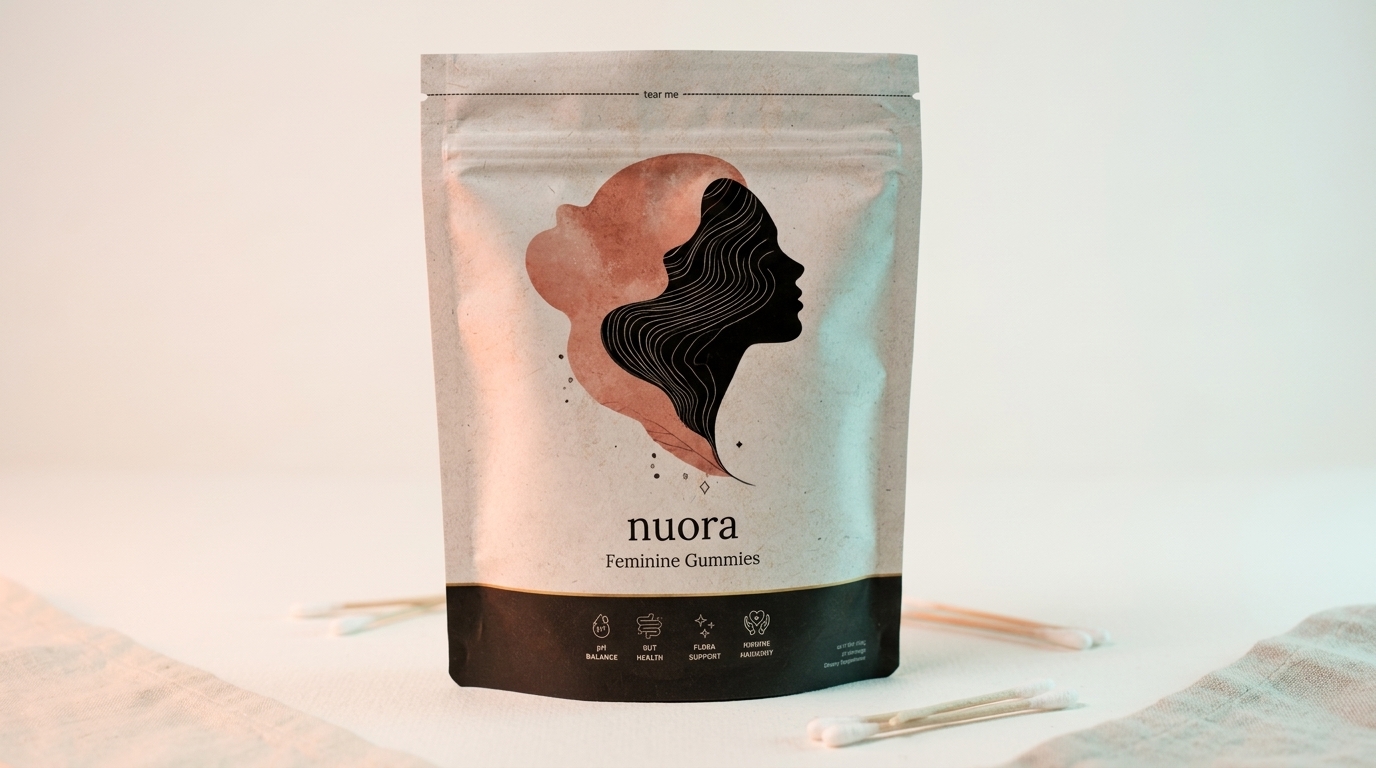
Most vaginal probiotics on the market contain only probiotic strains. They are trying to rebuild without ever clearing the ground.
Most pineapple supplements contain flavoring or extract without meaningful bromelain enzyme activity. And standalone bromelain supplements dissolve without rebuilding, leaving a vacuum.
They publish the exact strain designation on their label. They use stem-derived bromelain, not fruit-derived. They dose at clinical levels. These are verifiable claims you can check against their label and against the published literature.
How long before I notice a difference?
Most women notice the smell resolving within 5 to 9 days as the biofilm breaks down and the bacterial environment rebalances.
This is not a masking agent or a fragrance — it is a structural change that builds over the first week as the biofilm degrades and the probiotic strain establishes.
Can I just buy bromelain separately and take it with my current probiotic?
You could try, but two issues arise. First, most standalone bromelain supplements are not dosed for biofilm disruption — they are dosed for digestive or anti-inflammatory support, which requires far less enzymatic activity.
Second, most probiotics are not spore-forming, meaning they die in stomach acid and never reach the vaginal microbiome.
You would need to verify both the bromelain source and dose AND the probiotic strain type independently. Nuora has already solved that formulation problem.
What if I am allergic to pineapple?
Pineapple allergies typically involve proteins found in the fruit flesh. Bromelain is extracted from the stem, which has a different protein composition.
However, cross-reactivity is possible. If you have a confirmed pineapple allergy, consult your healthcare provider before starting any bromelain-containing supplement.
What if I have tried literally everything?
If you have cycled through antibiotics, boric acid, probiotics, and home remedies without lasting results, the biofilm is almost certainly the reason.
None of those approaches dissolve the biofilm structure. They all work around it. This protocol works through it — and then rebuilds what should have been there all along.
Is this safe to take daily?
The ingredients — bromelain, bacillus coagulans SNZ1969, and vitamin C — are all well-studied and have established safety profiles as daily supplements. Nuora is an over-the-counter formula.
As with any supplement, if you are pregnant, nursing, or on medication, check with your healthcare provider.
If what you have read here aligns with what you experienced in the video — and more importantly, with what you have experienced in your own body — the next step is simple.
Nuora's product page has the full ingredient label, the strain details, real customer reviews, and the current supply options.
Most women start with a multi-month supply because the 5-to-9-day biofilm disruption is just the beginning — maintaining the rebalanced environment is what keeps the smell from returning.
You now understand the mechanism better than most practitioners are currently trained on. The research is clear. The protocol is straightforward. And there is finally a formula designed around the correct sequence.
NUORA GUMMIES
Sincerely,
The Nuora Editorial Team
Women's Vaginal Health